
Undercarriage Services
Service – Cost Control
Factors Affecting Undercarriage and Track Wear: Multi-Terrain Loader (MTL), Compact Track Loader (CTL) & Mini Excavator
The materials you work in can have at least as much impact on the service life of Cat rubber undercarriage components as some applications. In general, the more abrasive the material, the faster components wear. For example: rocky, jagged material or construction debris will cause the most wear on undercarriage. The least wear will occur when working on soft, loamy soil or non-abrasive surfaces, such as turf and finished landscaping.

Maintenance
How to Extend Track Life on Caterpillar Rubber Track Loaders
Track Tension and Adjustment
A properly adjusted track maximizes not only the service life of the track, but also machine performance. Loose or overly tight tracks reduce service life and machine performance. Some slack in the track between the drive sprocket and front roller wheel is normal. Check regularly and adjust when needed:
Avoid loose tracks to prevent:
- Damage to lugs
- Possible derailment
Avoid tight tracks to prevent:
- Increased wear to tracks and roller wheels
- Increased wear to sprockets and drive motors
- Damage to lugs

Undercarriage Clean-Outs
Your machine’s undercarriage is often exposed to mud, gravel, debris, and other abrasive materials. Cleaning the undercarriage on a regular basis is recommended. How often the undercarriage needs to be cleaned depends on the material being worked in. A daily cleaning is normally sufficient. Cohesive and abrasive materials, like mud, sand, clay and gravel, should be cleaned out as often as possible, even several times a day, to reduce unnecessary wear to undercarriage components.
The timing of undercarriage cleaning can be a factor in how easy or difficult the job becomes. It is easier to remove materials like mud at the end of the day than the next morning, when it has dried.
In cold climates or whenever freezing temperatures are expected between work shifts, it is recommended to run the machine in forward and reverse before shutting it down to reduce moisture build-up and help prevent freeze-ups.

Selection
Track Selection
Non-Track Factors:
How many hours per year does your machine run?
- Less than 300 hours per year — General Duty Tracks may be the best option.
- 300 – 800 hours per year — General Duty or Premium Tracks are both great options, but it is important to consider the application and underfoot conditions.
- More than 800 hours per year — Premium Tracks are the best option.
How many operators will use this machine? How experienced are they?
- A single operator has a vested interest in taking care of his machine and operator station.
- Maximized track life is highly likely.
- A less experienced operator may consider productivity more important than total owning and operating costs.
- Lower track life may result from breakage or chunking.
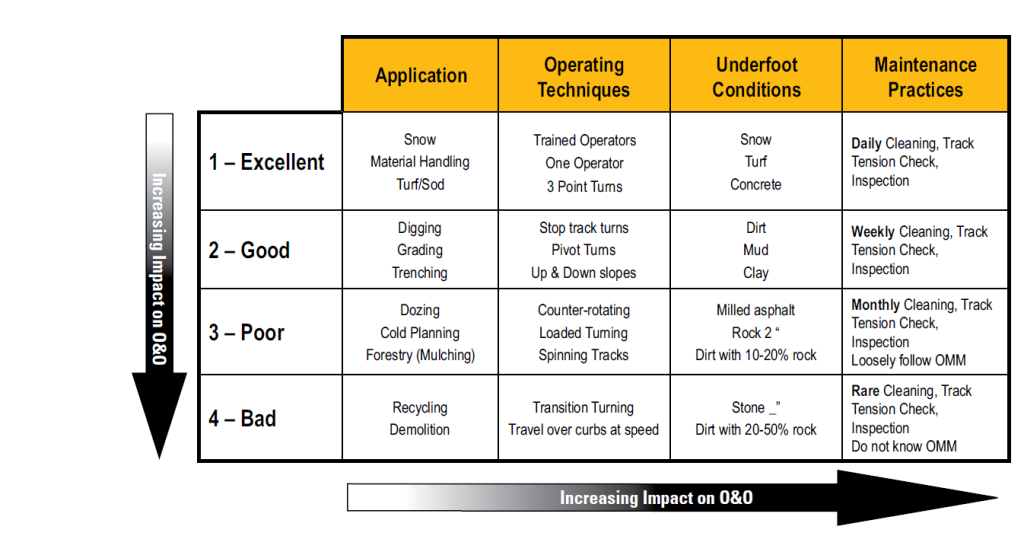
Working Conditions – Key Owning & Operating (0&0) Cost Factors
Determine the size of replacement track you will need if no part number is available:
- Measure the width of the track in millimeters.
- Measure the distance from the center of one link to the center of the next link (in millimeters).
- Count the number of links or lugs around the full length of the track.